
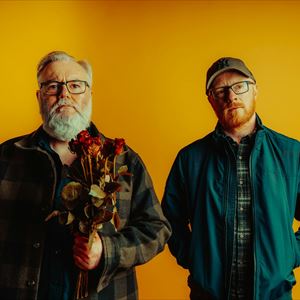
Arab Strap
Howard Assembly Room, Leeds.
14+ only. 14s to 17s must be accompanied by an adult. No refunds will be given for incorrectly booked tickets.
More information about Arab Strap tickets
"This time we put everything on it," says Arab Strap's Aidan Moffat. "We normally have three or four songs left over from a session but with this one, it was like, fuck it."
With a huge anniversary milestone imminent, there was a feeling of letting it all hang out. "We've done this for 30 years, so why hide anything? Why be unsure?" continues Moffat. "This way, it gives you a better picture of what we've been working on and shows the full breadth of what we're doing, and hopefully there's a few surprises."
The surprises are there from the off on the band's 14-track album, their third since reforming in 2016, having had a 10-year break before that. The opening 'I Get Noise' fuses big, heavy crunchy guitar riffs, crashing drums, and free flowing saxophone, as Moffat imagines searching for solitude and escape in a world of screeching uproar. "I thought it was quite funny that I was singing about yearning for a quiet life but then having something musically screaming in the background," he says of the duality of the song.
And then immediately we move onto 'You You You', a track that bubbles to life sounding like some long-lost killer Italo disco record - with Moffat's vocal refrain of the song's title creating one of the most outright melodically infectious songs the band have ever made - and that's before Malcolm Middleton's punchy and spiralling guitar lines burst through it. The result is something that feels like an entirely new genre. "A sort of disco-metal incantation," suggests Moffat. "With a message of future felicity and fellowship that - fingers crossed - might make you dance and giggle too."
Lyrically, the song is emblematic of some of the themes on the album. "'You You You' is an attempt to remind ourselves, and hopefully others, that the world's not full of awful people," says Moffat. "That there are millions of us out there dealing with the same worries every day: from the rising costs of absolutely everything, our mental and physical health, the constant slaughter and tyranny in our newsfeeds, to playing an unwitting part in the military-industrial complex, and the endless warping of reality. It can often feel like a complete absence of human decency - it's no wonder that despondency can feel like our default disposition." However, while the song digs into these troubles and tumultuous times, it does so with a purpose. "It was designed as a kind of invocation," says Moffat. "To bring forth the stubbornly elusive spirits of hope and solidarity."
The push-pull dynamic that exists in such songs - where grooving, fluid beats nestle up against rip-roaring guitars - is reflective of the back and forth approach the band have during the songwriting process. "The excitement comes because me and Aidan like and hate different things," says Middleton. "There are things in the record that individually we might not choose but that's why I like this album so much, because it's not the one I wanted to make. I don't think it's what Aidan wanted to make either, it's this bit in the middle. It might not be 100% what we want but it's good for the band, and it works."
Elsewhere, the album stretches out into eclectic and electric terrain. 'Glamour Magick' is one of the many tracks that have clearly sprouted up because of the horror that Moffat finds when on his phone, and the result's an almost Fall-like dark satire about the wellness industry in the social media age. Over fizzy beats and tender piano, 'Be a Man' is a touching and poignant rumination on fatherhood in the age of the manosphere and exploring notions of growing up.
While 'Fighting for You', inspired by a line from author Natasha Brown's political satire, Universality, is a fierce and fiery take down of far-right grifters, hollow nationalism and spineless leaders, with Middleton's potent guitar playing mirroring the tone of the subject matter. "It's about certain political figures and demagogues that I don't trust to look after anyone's interest, especially the working classes," says Moffat. "But I'm trying to do that in as fun a way as I could - to make it quite entertaining without getting too grim."
Despite the album tackling a lot of weighty issues, from the personal to the political, it was important for Moffat to anchor himself to optimism within those subjects. "I think there's a hope in there," he says. "There's actually some genuine joy in the record. I was quite conscious of that, as the last one was really dark."
Perhaps the most prevailing theme across the record is time however. "The album title sounds like a fairy tale book, until you get to the end of the record and you realise that I'm talking about lives that have ended too early," says Moffat. "That's something that just seems to be part of your life when you get to your fifties. You become acutely aware that you're in that final third of your life. I think every single song has some element of time or some discussion of its passing and how to use it as best you can while you have it."
It's pretty remarkable to have an album that runs the gamut from disco to metal via post-rock, spoken word, complete with flourishes that span everything from folk to electronica, and still retain an unmistakable core identity. But this is what makes Arab Strap still such an exciting and dynamic band at this point: they retain their inimitable characteristics while also continuing to push on into new directions and musical terrain. "We always try different styles but it always sounds like us," says Middleton. "Whether it's a samba drum beat or a dance beat or live drums. Our identity just comes through in the studio."
And for Moffat, it feels symbolic of where they are currently at. "The best thing to celebrate our birthday was to do something that was new, interesting and exciting for us to play," he says. "The last thing we wanted to be was one of these heritage bands that just keep touring old records."
By Daniel Dylan Wray
“It's about hopelessness and darkness,” says Aidan Moffat. “But in a fun way.” The Arab Strap frontman is speaking about the band’s 7th studio album and their first since 2005’s The Last Romance.
The pioneering Falkirk duo of Moffat and Malcolm Middleton called it a day in 2006 but got back together 10 years later to perform a series of acclaimed and sold out shows. “We really enjoyed doing those gigs,” recalls Middleton. “So it made sense to try writing together again”.
Prior to splitting up the band released a string of acclaimed releases spanning albums such as Philophobia, The Red Thread and Monday At The Hug and Pint, several EPs and that most difficult of tasks: a genuinely stunning live album via Mad for Sadness.
Arab Strap started out as an intimate project with home-recorded tapes shared between friends, but after the unexpected success of their inimitable debut single ‘The First Big Weekend’ they quickly found themselves, along with pals Mogwai, as some of the most exciting and cherished music coming out of Scotland. The band’s first gig was recorded live for John Peel, who became an early devotee. The band went from indie record label Chemikal Underground onto the major label Go! Beat and then back again to Chemikal, touring the world and funnelling life’s experiences into a unique concoction of music that explored beauty, sadness, intoxicants, sex, love, and death all rolled into one.