
The Clockworks
Brudenell Social Club, Leeds.
14+ only. 14s to 17s must be accompanied by an adult. No refunds will be given for incorrectly booked tickets.
More information about The Clockworks tickets
Look up. Look around you. What do you see? A row of commuters, lost in their phones. People in pubs looking at small screens, sat under bigger screens. We were sold the possibility of infinite connection, but all it really did was pull us further apart. Because in the modern world, there's no more alluring temptress than technology and she's rarely, truly on your side.
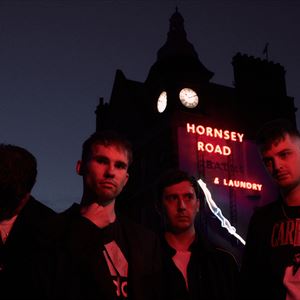
When Galway-born, London-based alternative quartet The Clockworks wrapped up touring for their debut album, 2023's 'Exit Strategy', they concluded a game-changing period of their lives that was buoyed by a greater sense of community than ever. That record had cemented the importance of their move to the capital. Not only had it led to them working with Bernard Butler on the album, but it had also set off a domino chain of pinch-me events that saw them tick off support tours with some of their heroes. In 2022, they were taken on the road in the US by Pixies; last year, they wrapped up a string of dates with Johnny Marr.
The latter was so enraptured by the band that he would wander around the venue corridors, loudly singing their songs. "We were playing with these people who are the reason we play music. It makes you feel like you've realised something that you always wanted to do as a musician: forming bands, making albums, being able to shake the hands of people who've meant so much to you and tell them that," recalls Tom Freeman.
It was a monumental time for The Clockworks - completed by James McGregor, Sean Connelly, and Damian Greaney - but when they stepped back into the writing room, they soon had the instinct to turn their focus elsewhere. The new material that swiftly began pouring out of McGregor was rooted in a very clear and distinct world that looked outside of their creative bubble and saw a society wrestling with an increasing isolation born from shiny new toys and bright lights.
The framework of 'The Entertainment' came intuitively and fast. "We had this really strong identity for the album from the start," explains McGregor, "which meant that we could then spend so much time on the details. It's like if you have all the beats of the film, then you can tell the actors to go and improv between them." The Clockworks are calling their second record not so much a concept album as - cleverly - "a work of friction". "Friction is the best word because the whole album seems to be filled with push and pull, black and white," continues Freeman. "There's such a conflict and contrast between everything. Even just recording the music, we did it all separately and then put it back together."
In stark contrast to their debut, which had been laid down with Butler in a flurry of activity, running on snap decisions with no time to look back, 'The Entertainment' was produced by Sean Connelly, recorded over a period of months and using almost meta techniques to mirror the jarring conceits inside. "We had the idea to record in a way that was in keeping with what the album is talking about, and to try and do it in isolation completely. We wanted creatively to turn in and see what we could do without anyone looking at it, as a trust fall exercise for the four of us," explains McGregor. Not only would the band eschew any outside voices, they would also record their own parts in isolation. "So then when we did bring them all together, the parts had all this tension to play with," the frontman says.
With Freeman and Connelly having massively upscaled their production abilities in the years since 'Exit Strategy', the band began slowly chiselling away at the raft of ideas they'd accumulated, carving out a sonic landscape for 'The Entertainment' built around tension and release; moments of darkness juxtaposed with glimmers of light. A raft of cinematic inspirations were on the moodboard: Bladerunner, Drive, the works of Fellini. Setting the tone for a project steeped in "the sheen and slickness that slams against the ugliness and depravity of Hollywood", their influence was integral, as evidenced by a trio of songs on the record - 'La Dolce Vita', 'The Magnificent Seven' and 'True Romance' - named directly after films. When they were fine-tuning darkly anthemic recent single 'Well Well Wellness', meanwhile, they played the demo alongside clips from The Bear. "We knew we were on to a winner because the song was sounding how we thought the show looked and felt, and that's a show about life and being human," says Freeman.
Musically, meanwhile, nothing was off limits for the quartet. "Our first album was pretty much four lads in a room making noise, but this album has so much piano, synths, string arrangements, found sounds, weird noises..." McGregor explains. "We grew up with The Strokes and The Libertines, but we have too much interest in other things to contain ourselves to that."
Ask The Clockworks to list a fraction of their listening habits and they'll reel off everything from Little Simz to Ennio Morricone to Beach House and AG Cook. 'The Entertainment''s rattling opening track 'How To Exist', McGregor explains, was influenced by the energy of Simz and Kendrick Lamar. A manifesto of sorts, it transports the listener to the beginning of a journey that slowly moves through headspaces and moods. The melancholy self-delusion of 'Best Days' details a relationship already doomed to fail, while 'La Dolce Vita' begins with an opening image lifted directly from the 1960 Fellini film: "The floor is shaking and the walls are sticky / Someone said that Jesus took a chopper out the city". "It sets up this idea of the death of religion, the death of values and what's coming in to replace that," McGregor suggests.
By the album's midway point, we've reached 'The Magnificent Seven', a pulsing electronic highlight that sounds like Franz Ferdinand covering Sleaford Mods. Its titular concept is one of the record's cleverest moments - a looping together of the old Western classic and the modern West with its billionaire corporations into one hellish whole. "I heard an economist mention The Magnificent Seven in reference to Apple and Microsoft and the big tech giants," McGregor explains. "In the film, the cowboys are there to liberate the village, so the irony of the Big Seven companies and their messiah complexes [felt apt]."
Throughout, the instrumentation and production hones in on this narrative. 'How To Exist' begins with "vocal production tricks and a thousand instruments that could never be played exactly like that by the four of us in a room"; the final notes of 'The Entertainment''s title track were recorded live, in one take, with all the pops and background noise left in. "It's not that we saw the light and in the end, you know, you just have to sit with the guitar!" McGregor notes with a laugh, but there's a tangible point about finding real human connection that sits just below the surface.
On the record's artwork, the band are seated in a cinema screen, replicating an old LIFE Magazine cover featuring the first theatre to show 3D films. Back then, the technology seemed fantastical; now, we can see people putting a blinker around their vision - the start of many to come. With their second, The Clockworks are highlighting that duality but they're also offering a tangible reason to support the alternative: a group of mates, making music to get you off a screen and into the world. That, after all, is really entertainment.